


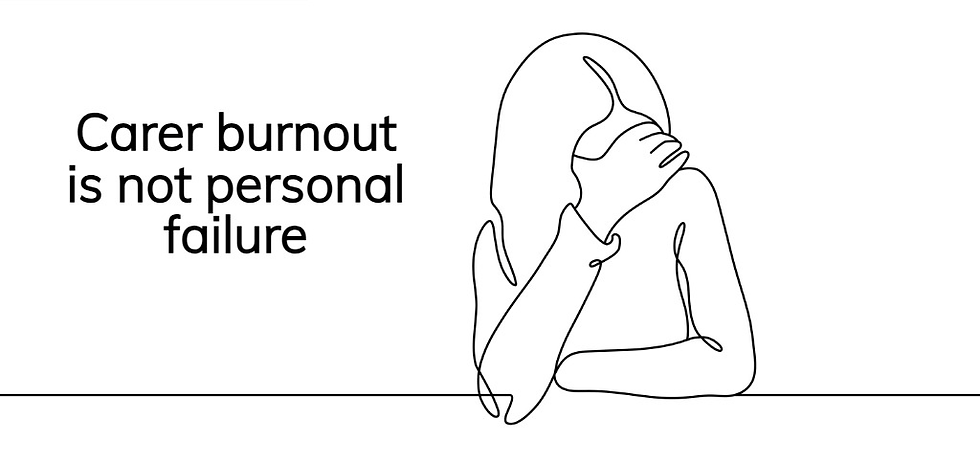
Carer Burnout is not Personal Failure
Updated: Mar 24
Burnout Is Not a Personal Failure: The Honest Reality for Carers of People Living with Young Onset Dementia in Aotearoa New Zealand
Caring for someone living with young onset dementia (YOD) is not simply a role, it becomes a way of life. In Aotearoa New Zealand, where young onset dementia remains poorly understood and chronically under-resourced, carers and whanau often find themselves navigating a system that quietly assumes resilience without providing the structural support required to sustain it. In this context, the idea that burnout can be “avoided” is not only unrealistic—it can be harmful.
When Life Becomes a System
One of the most honest truths carers speak of is the loss of freedom and personal choice. Daily life becomes governed by routines, appointments, schedules, behavioural changes, financial pressures, and constant vigilance. As one carer reflected:
“The whole life, the whole daily structure starts to follow patterns. There is no freedom anymore. It is a pattern. You are being controlled by circumstances. You are a part of a wheel of a part of a system… you’re just functioning, you’re living a functional life.”
This captures a reality many carers know intimately. The caring role slowly replaces other identities, partner, parent, professional, friend, confidant. Life narrows. Life and individual choice diminishes. What remains is functioning: keeping things going, holding things together, surviving day to day.
In Aotearoa, carers of people with YOD often fall between systems, un-noticed, unfit. Services are largely designed for older people with dementia, leaving younger families without age-appropriate support, meaningful respite, or flexible employment protections. Financial stress compounds emotional strain, particularly when the person living with dementia was previously a key income earner. For many whānau, the system does not bend—it presses harder.
Burnout as an Inevitable Outcome, Not a Failure
Burnout is frequently framed as something carers should prevent through self-care, resilience, or better coping strategies. But this framing ignores the structural reality. Burnout is not caused by carers failing to look after themselves—it is caused by prolonged exposure to unrelenting demand without adequate support.
When carers are told they must “avoid burnout” in a system that offers minimal respite, fragmented services, and little recognition of the intensity of YOD care, the message subtly becomes: If you burn out, it’s your fault.
In truth, burnout is a rational response to an irrational situation.
Nature as the Absence of Demand
Some carers describe moments in nature as the only spaces where they are not required to function. Not as carers. Not as advocates. Not as problem-solvers.
“When you are out there walking in the garden or walking in the forest, there is nothing that the forest and the nature needs from you. You don’t need to function.”
This absence of demand is profound. Nature does not ask carers to explain themselves, to manage behaviours, to plan ahead, or to hold everything together. It simply allows existence.
“The only thing you need to do is realize this is what it is. Welcome to existence. There is nothing to add to this.”
In a life dominated by responsibility and pressure, these moments are not luxuries—they are lifelines. Yet for many carers, even access to such moments becomes rare. The longer someone is “trapped inside the system,” the fewer opportunities they have to step outside it. The result is not just exhaustion, but a deep erosion of self.
The Cost of Constant Functioning
The danger is not just physical or emotional fatigue—it is the loss of being. When carers spend most of their time functioning, they begin to feel trapped rather than alive.
This is where burnout lives—not as a sudden collapse, but as a slow, cumulative wearing down. In the context of YOD, where the journey is unexpected, long and the progression unpredictable, this erosion can span years or decades.
A Call for Systemic Change in Aotearoa
If we are serious about supporting people living with young onset dementia and their whānau in Aotearoa New Zealand, we must stop pretending burnout is avoidable through individual effort alone. We need:
Age-appropriate and flexible respite options
Financial and employment protections for carers
Recognition of carers as essential partners in care, not invisible labour
Space—real space—for carers to step out of constant functioning
Until these supports exist, burnout should be understood not as a failure, but as evidence of love, endurance, and a system that asks too much and gives too little.
Beyond Survival
Nature reminds us of something carers often forget in the machinery of care: life is not only about functioning. Carers deserve more than survival. They deserve moments of existence without demand, without judgement, without systems pressing in. Until we build a society that truly supports those living with YOD and their whanau, burnout will remain not just likely—but inevitable.


